How to rank in AI Search results
How to rank in AI search results (when Google isn't the only search engine anymore)
Search has split.
For most of the last 25 years, ranking meant one thing: get onto page one of Google. Blue links. Ten results. You knew the goal.
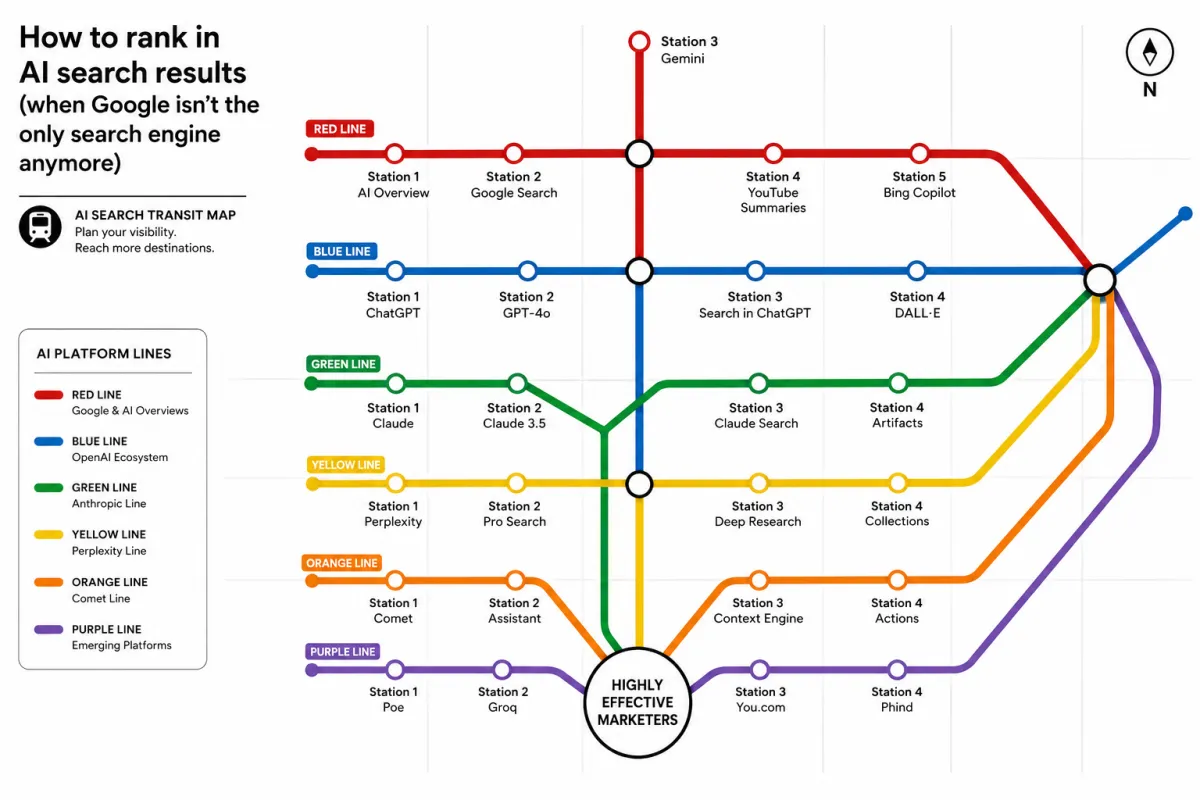
In 2025 and 2026, that model has fractured. Google still matters — but now there's AI Mode (Google's fully conversational search tab, launched May 2025), there's AI Overviews appearing above organic results for hundreds of millions of queries, there's Perplexity sending meaningful referral traffic to content it cites, and there's ChatGPT Search being used by people who'd rather ask a question than scroll through results.
In each of these, the visibility mechanism is different. There are no ten blue links. There's an AI-generated answer — and your content either gets cited as a source, or it doesn't exist.
For marketers managing client SEO, this isn't a future concern. It's the current landscape. The question is what you can actually do about it.
What GEO is (and what it has in common with traditional SEO)
Generative Engine Optimization — GEO — is the practice of making your content more likely to be cited by AI systems when they generate answers.
The principles aren't completely foreign. AI systems are trained on content that demonstrates expertise, provides clear direct answers, and is well-structured. So the foundation of GEO overlaps significantly with good SEO: write with real depth, be accurate, structure content logically, build topical authority over time.
Where GEO diverges is in the specific mechanics. Traditional SEO is about ranking a URL. GEO is about getting specific passages extracted and cited. The unit of currency isn't the page — it's the sentence or paragraph that answers the question clearly enough for an AI to pull it out and attribute it.
That shift has real implications for how you structure content.
The content structures AI systems actually cite
AI systems don't cite pages at random. They cite passages that meet a few structural criteria consistently.
Direct answers to specific questions. If someone asks "what is a good email click-through rate," the AI is looking for a sentence that directly answers that. "A good email click-through rate is typically 2-5% depending on industry and list quality" is citable. Two paragraphs discussing the history of email metrics leading up to a tentative conclusion is not.
The practical implication: lead with the answer, not the context. Many content writers bury the key claim halfway through a section. For AI citation, that claim needs to be in the opening sentence of the relevant section, stated plainly.
Structured question-and-answer formatting. FAQ sections within articles perform particularly well for AI citation. Not because FAQs are magic, but because they force the question-answer format that AI systems are trained to extract. If a topic naturally lends itself to "people also ask" style questions, build those directly into the content rather than writing around them.
Numbered frameworks and step sequences. "Here are the 4 criteria for evaluating X" or "the 3-step process for Y" are highly citable structures. AI systems can extract a clean, discrete framework and attribute it. An equivalent amount of information written in flowing prose is much harder to extract cleanly.
Data points with clear attribution. Specific statistics with named sources get cited more frequently than general claims. "According to Mailchimp's 2025 benchmark report, average email open rates across all industries are 21.5%" is citable. "Email open rates vary and benchmarks differ across industries" is not.
If your content currently has real data buried in paragraphs, restructure. Pull the statistic, cite the source, give it its own sentence.
Topical authority: why one good article isn't enough
AI systems don't just evaluate individual pages. They evaluate the broader authority of a source on a topic.
A site with 25 articles covering email marketing from multiple angles — strategy, deliverability, copywriting, segmentation, automation — will get cited more consistently on email marketing queries than a site with one excellent email marketing article. The depth of coverage signals genuine expertise rather than a single well-optimised post.
This is the content cluster argument, and it applies more strongly in GEO than it ever did in traditional SEO. The individual article still needs to be good. But the surrounding context of related content is what tells AI systems you're a credible source on the topic rather than a one-off.
For marketers building content strategies for clients: topical clusters aren't just a nice architecture choice anymore. They're a GEO requirement.
Entity clarity and structured data
AI systems build their understanding of what a website is — and who it's for — partly from structured data.
At minimum, your site should have:
Organisation schema with accurate name, URL, and description. This tells AI systems what the brand is and what it covers.
Author schema on every article. AI systems give higher weight to content with a clearly identified author who has expertise in the topic. "Written by Camelia Vasile, digital marketing strategist with 20 years' experience" is more citable than an anonymous post. Include author bio pages and link them from the articles.
Article schema with publication date and last-modified date. Freshness matters. AI systems are often calibrated to prefer recent sources, particularly on fast-moving topics. A 2022 article about AI search strategy is a liability.
These aren't complex technical implementations. Every major WordPress SEO plugin handles them. The problem is most sites either haven't set them up, or set them up once and haven't checked them since.
Google AI Mode and AI Overviews: different beasts
Google AI Mode and Google AI Overviews behave differently and warrant separate attention.
AI Overviews appear above the organic results for queries Google judges as having clear informational intent. They pull content from pages that rank in the top positions for the query — and are heavily influenced by traditional SEO signals. If your page already ranks well for a keyword, it's a candidate for inclusion in the AI Overview. The way to optimise specifically for AI Overview inclusion is to make sure the relevant passage on the page directly answers the query in the first two paragraphs of the relevant section.
AI Mode is a separate tab in Google Search, available for users who actively choose the conversational experience. It returns zero organic blue links. Visibility in AI Mode is purely about citation. The GEO signals above apply here: direct answers, structured content, topical authority, entity clarity. A page that doesn't rank particularly well in traditional search can still get cited in AI Mode if the content is well-structured and clearly answers a relevant question.
The practical takeaway: don't treat them as the same thing. AI Overviews are largely an extension of traditional SEO. AI Mode is a separate citation problem that requires deliberate GEO work.
The llms.txt question
Some SEOs are experimenting with an llms.txt file — a plain-text file in the root directory of a site that tells AI crawlers which pages are authoritative and which to skip. It's an emerging convention, not a standard, and adoption among AI systems is inconsistent.
Worth knowing about. Worth implementing if you're in an industry where AI visibility is a meaningful traffic driver. Not worth prioritising over the structural content improvements above, which have demonstrable impact.
What to actually do this month
If you're managing SEO for a client and want to start addressing AI visibility without a full GEO audit, three things move the needle fastest:
Go through the top 10 ranking pages on the site and check whether each one has a clear, direct answer to the primary query in the first paragraph of the main section. If the answer is buried or implied rather than stated, rewrite that paragraph.
Add or update author bios on all content pages. Link to an author profile page that establishes expertise. If it's a client with a founder-led brand, the founder should be credited by name on relevant articles.
Pick the 2-3 topics the site most wants to be associated with and map out whether there's a content cluster around each one. Identify the gaps — the questions that should have articles but don't — and prioritise them.
That's a week's work for a competent content strategist. And it addresses the majority of GEO weaknesses most sites have right now.
The sites getting cited in AI results in 2026 are mostly doing these basics well. The ones being ignored aren't technically failing — they're just not optimised for how content gets evaluated in a world where the answer is the product.
Pitching an AI search strategy to a client? The HEM free toolkit includes a strategy one-pager template — a clean format for presenting a strategic recommendation that doesn't require a 40-page deck.
[DOWNLOAD THE FREE TOOLKIT]