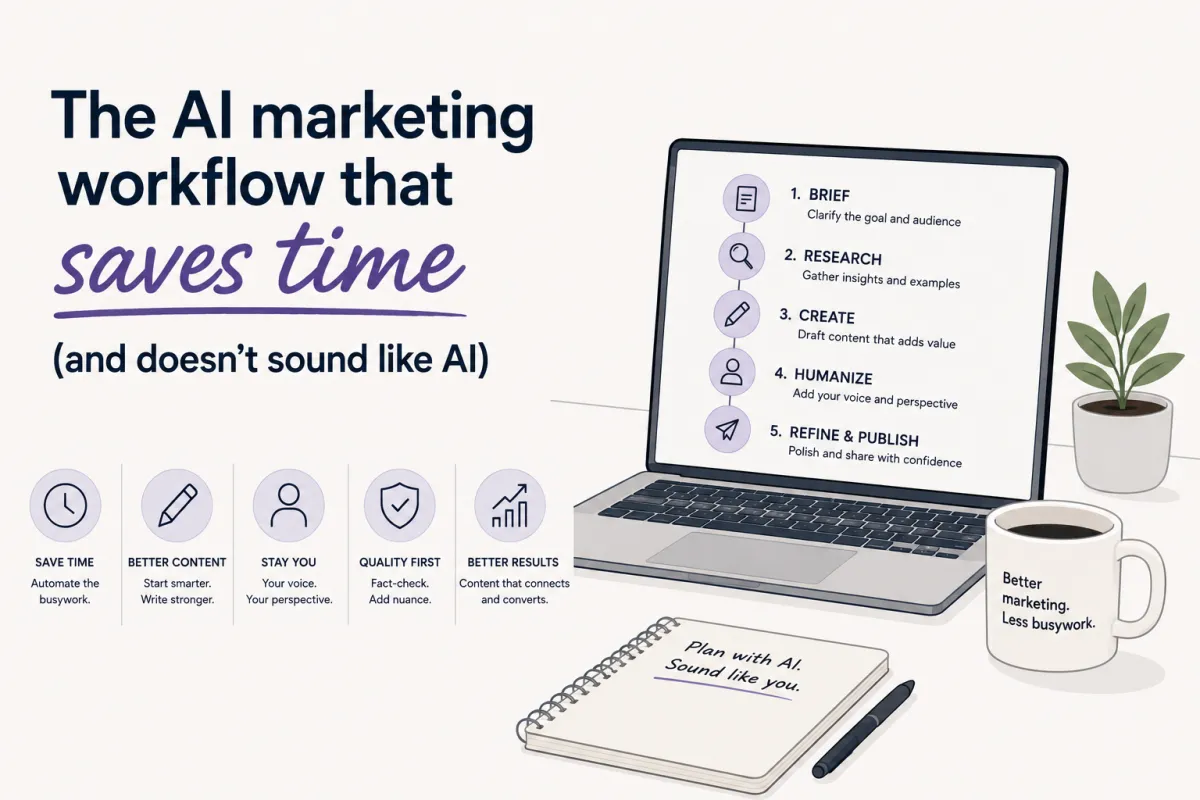
The AI marketing workflow that really saves time (and doesn't sound like AI)
The AI marketing workflow that really saves time (and doesn't sound like AI)
91% of marketers are using AI now. Up from 63% last year. So the adoption question is settled.
The productivity question is not. 74% of companies still struggle to get real value from their AI tools. 61% of marketers report buyer's remorse on their last AI tech purchase. The average team is running more tools than ever and recovering about 6 hours a week — which sounds good until you account for the time spent managing, prompting, reviewing, and correcting what the tools produce.
The marketers saving 8-10 hours a week aren't using more tools. They're using fewer, better, in a coherent workflow. They've also been burned enough times to know exactly where the tools earn their place and where they quietly make things worse.
The shift that actually matters in 2026
The first wave of AI tools was generative: ask, receive, edit, publish. You triggered every step. The current wave is agentic: systems that take a goal and execute multi-step workflows autonomously, making decisions along the way without waiting for you to move them forward.
This distinction matters for how you think about your workflow. Generative AI is a faster keyboard. Agentic AI is closer to a junior colleague who can handle a defined process while you do something else — as long as you've set up the process well and know when to check the work.
In practice: an agentic setup might monitor your inbound leads, pull LinkedIn and website data, draft a personalised first-touch email, and surface it for your review before it goes anywhere. Or watch your campaign performance, flag anomalies, and draft a summary with recommended actions. The human bottleneck moves from execution to judgment. That's where senior marketers should be spending their time anyway.
The tools that deliver this best right now are the ones connected to your actual data — your CRM, your ad accounts, your analytics — rather than running in isolation. A standalone AI writing tool is generative. A tool plugged into your campaign stack that monitors, synthesises, and surfaces decisions is agentic. Both have their place. They're different tools for different jobs.
Where the workflow actually earns back time
Research and synthesis. Feed a 40-page report, a competitor's website, a transcript, a set of customer reviews into Claude and ask for the key findings and what they imply for your strategy. A task that used to take an hour takes 10 minutes. The output needs a human check — AI will confidently flatten nuance if you let it — but the starting point is solid.
For external research, Perplexity is more useful than ChatGPT because it cites sources. When you need a fact to anchor a brief or a stat to support a strategy recommendation, Perplexity gives you something verifiable. ChatGPT gives you something that sounds right. Those are not the same thing.
Brief writing. Dump your strategic diagnosis — the problem, the audience, the constraints, the objective — into Claude and ask for a creative brief. What comes back is 70% there. Faster to refine than to write from scratch, which matters when you're managing a team and briefs are a throughput bottleneck.
First drafts. AI writes fast and writes average. That's useful for scaffolding — an outline to react to is faster to work from than a blank page. The edit pass is not optional, and it should take at least as long as the AI saved you on the draft. The job is replacing the generic vocabulary, adding specific examples, and making it sound like a person with a point of view wrote it.
Repurposing. Once a piece of content already sounds like you, AI handles reformatting well. Blog post to LinkedIn draft to newsletter intro to short video script — give it the source piece and a clear instruction for each format. The output stays closer to your voice when it's reworking your material rather than generating from scratch.
Where it makes your work worse — and one specific horror story
The failure modes are worth naming precisely, because they're not obvious until you've experienced them.
Copy that goes out unedited. The tell for AI-written content isn't just the vocabulary (though "leverage," "seamless," "transformative," and "delve" are still in there like fingerprints). It's the rhythm. AI text is metronomic: every sentence roughly the same length, every paragraph the same structure, every section ending with a tidy summary. Real writing breathes unevenly. An edit pass that only swaps words and misses the rhythm problem still sounds like a machine wrote it.
Strategy without your diagnosis. AI has no business context. It doesn't know your client's competitive situation, the internal politics that killed the last campaign, or the sales cycle that means September is not when you push the premium offer. Feed it a strategic brief and it'll produce something structurally coherent and substantively wrong. Using AI for strategy before you've done your own diagnosis produces decks that look good and do nothing.
Automated tools running without supervision. This is the one that burns teams badly. Meta's Advantage+ feature has been quietly swapping out creative elements in ad sets — in at least one documented case, replacing a top-performing original ad with an AI-generated image of an elderly woman. The marketer didn't approve the change. They found out when performance collapsed. The tool was optimising. It just wasn't optimising for what the brand needed.
Agentic tools that connect to your live campaigns need active oversight, not passive trust. The efficiency gain is real. So is the downside when something unexpected gets automated at scale.
The tools worth actually using
The expensive specialist platforms — Jasper, Copy.ai, and their various competitors — are mostly not worth the subscription for senior marketers. The quality ceiling is the same as Claude or ChatGPT with a good prompt, at a fraction of the cost. They're designed for high-volume content production teams that need a guardrailed interface. That's a different problem.
Claude is the default for anything that requires nuanced writing, editing, or document-level work. Longer context window, better tone control, handles ambiguity better than most. Feed it your brief and your voice guidelines and it stays on track further into a long piece.
ChatGPT is useful as a second opinion — different training data, different tendencies. If you're working through a strategic question and want a challenge to your own thinking, running the same brief in both surfaces assumptions you didn't know you were making.
Perplexity for any research where you need to verify sources. Don't skip this step if the claim matters.
Descript if you're working with audio or video. Transcription, editing, repurposing recordings into written assets — it genuinely saves hours on content that would otherwise require a separate production workflow.
HubSpot Breeze and similar CRM-integrated AI if you have the data infrastructure to support it. The use case where agentic AI delivers the most ROI is lead research and first-touch personalisation at scale — but only if your CRM data is clean. Garbage in, confidently personalised garbage out.
The right stack is 5-8 tools in a connected workflow, not 20 tools with overlapping functions and no clear ownership. Most teams using AI inefficiently are using too many tools, not too few.
The problem you won't see on a dashboard
There's a slow-burn risk in heavy AI use that doesn't show up in time-tracking or output metrics.
Optimizely surveyed marketing leaders on AI use in 2025 and found a "passion-pressure paradox": AI is saving time, but it isn't restoring the creative and strategic work that time was supposed to free up. The execution work has been automated. The thinking work hasn't expanded to fill it. The result is faster output that feels less like the kind of work people went into marketing to do.
The more specific version of this, for individual practitioners: voice drift. Run your AI-assisted work next to something you wrote entirely yourself 18 months ago. If the gap is noticeable — if the older piece has more edges, more specificity, more of an actual point of view — your workflow has drifted toward output and away from thinking.
The fix is deliberate. More time at the diagnosis stage. More time editing for opinion rather than just accuracy. Treating the AI output as raw material rather than a finished draft that needs light polish.
Senior marketers who are getting this right aren't just orchestrating AI tools efficiently. They're protecting the 20% of the work — judgment, perspective, relationships, strategic context — that AI can't replicate, and that's become more valuable precisely because the other 80% is now faster.
Want more of this — specific tools, real workflows, honest takes on what's worth using?
The HEM list is for senior marketers who want to stay sharp without drowning in AI content about AI. Frameworks and tools, no hype.
[SUBSCRIBE TO THE HEM LIST]