The pipeline-driving content strategy framework (vs. the one in your deck)
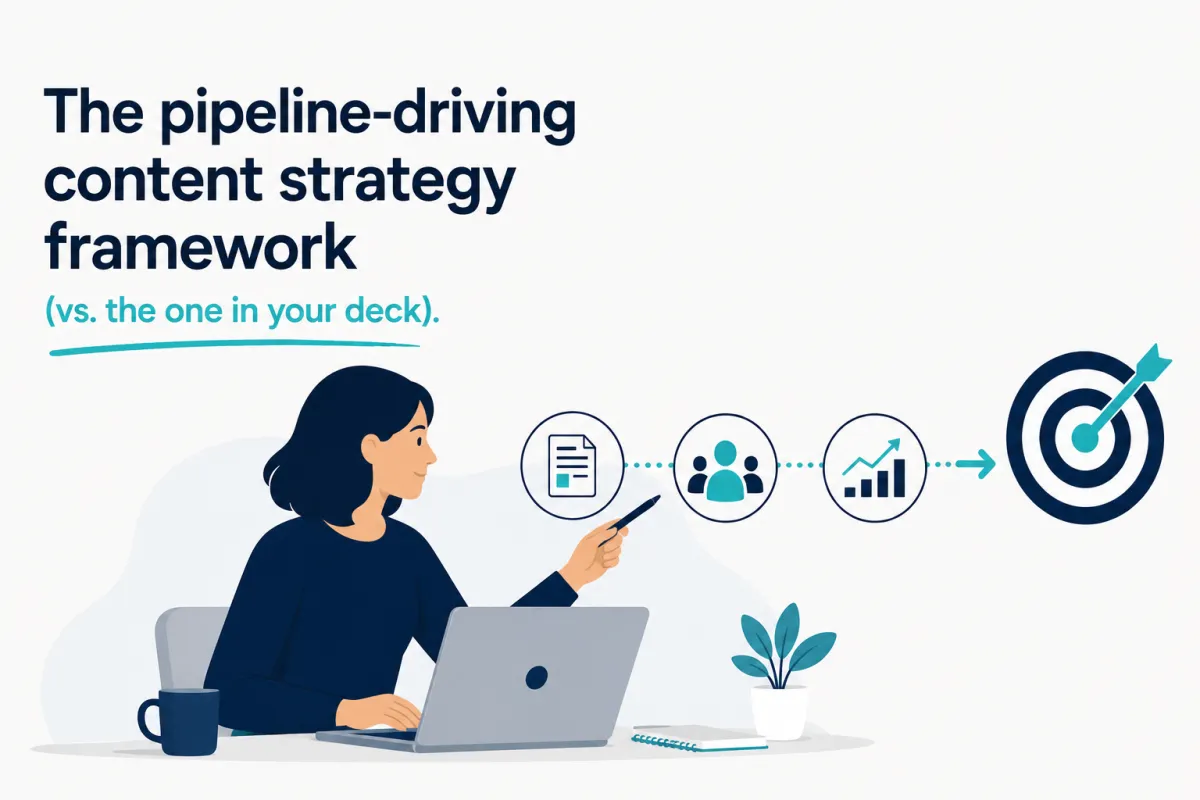
The pipeline-driving content strategy framework (vs. the one in your deck)
Most content strategies look great in PowerPoint.
There are pillars. There's a content mix — owned, earned, paid. There's a funnel diagram with awareness at the top and conversion at the bottom. There are audience personas with names like "Strategic Sarah." The whole thing is coherent and well-structured and takes about 20 minutes to present.
And then the team goes back to their desks and publishes whatever is easiest to produce this week. A blog post about an industry trend. A LinkedIn post recapping a webinar. A case study that took three months to get approved. Nothing maps to the framework. Nobody checks.
This isn't a discipline problem. It's a framework problem. The standard content strategy architecture is built to present well, not to operate from.
The version that actually drives pipeline looks different from the inside.
The problem with content pillars
Content pillars are a useful organising concept for editorial planning. They're a poor tool for pipeline thinking.
A pillar like "thought leadership" or "product education" tells you what type of content to make. It doesn't tell you what problem the content is solving at a specific stage of the buyer journey, what action it's supposed to prompt, or how you'll know if it worked.
When a content team organises around pillars, they tend to produce content that fits the category rather than content that does a specific job. The pillar is satisfied. The pipeline isn't moved.
The better organising principle is pipeline stage. Not funnel (which is a visual metaphor that doesn't tell you anything about what to make) — pipeline stage. Where is the prospect in their decision, and what do they need from content at that specific moment?
The pipeline-stage framework
There are 4 stages worth designing content for. Each one has a distinct job and a distinct content type that serves it well.
Stage 1: Problem aware, solution unaware
The prospect knows something is wrong. They can describe the symptom. They don't yet know what category of solution exists or that you're in it.
Content that works here: specific, searchable problem-framing content. Blog posts and articles that articulate the problem with enough precision that the right reader thinks "this is exactly what I'm dealing with." The goal isn't to mention your product. The goal is to demonstrate that you understand the problem better than anyone else writing about it.
This is where most B2B content gets wrong — it's technically about the right topic, but it's written from the solution side. "Here's why [category of solution] matters" is a different article than "here's what it actually looks like when [specific problem] goes unaddressed." The second one finds the prospect where they are.
Content types: blog posts, organic social, SEO-optimised long-form, short video for discovery.
Stage 2: Solution aware, evaluating options
The prospect knows what category of solution they need. They're comparing options — your category, adjacent categories, doing nothing, building it themselves.
Content that works here: comparative, opinionated content that helps them evaluate. Not "why we're the best option" — that's self-serving and they know it. Rather: "here's how to think about this decision, here are the criteria that matter, here are the tradeoffs." If your product genuinely performs well against honest criteria, this content does the selling without reading as a sales pitch.
Case studies belong here, but only if they're written from the outcome side rather than the process side. A case study that says "we ran a campaign and here are the results" is less useful than one that says "here's the specific problem this client had, here's why the standard approach doesn't work for it, and here's what actually moved the needle."
Content types: comparison content, opinionated guides, case studies (outcome-led), webinars and demos.
Stage 3: Decided, needs to justify
The prospect has effectively made a decision internally. They need help getting it across the line with a stakeholder — a budget holder, a team, a board.
This is an underserved content stage. Most content strategies go from evaluation to purchase without accounting for the internal sell. But in B2B especially, the prospect who's ready to buy often can't buy alone. They need a business case, a benchmark, a risk assessment, an answer to "what happens if this doesn't work?"
Content that works here: ROI frameworks, benchmark data, risk mitigation narratives, anything that helps the buyer advocate for the decision internally. Think "what would they need to show their CFO."
Content types: ROI calculators, business case templates, benchmark reports, one-pagers designed to be shared internally.
Stage 4: Post-purchase, building commitment
The prospect is now a customer. The content job here is to increase product usage, build switching costs through habit and integration, and create the conditions for referral and expansion.
Most content teams don't own this stage — it gets handed to customer success or onboarding. That's a missed opportunity. Content that helps customers get faster results, avoid common mistakes, and understand the full capability of what they've bought produces better retention numbers than almost any other investment.
Content types: onboarding guides, advanced use case content, community content, quarterly roundups for existing customers.
Why this beats the pillar model
The pillar model tells you what to make. The pipeline-stage model tells you what job to give it.
Every piece of content you plan should have a stage assignment and a defined action you want the reader to take at the end of it. Not "share this" or "leave a comment" — an actual next step in their relationship with you. Sign up, download, book a call, forward this to the person who handles X.
When a piece of content doesn't have a clear stage assignment, it usually means you're making it because it seemed like a good idea rather than because there's a gap in the pipeline. Good idea content fills calendars. Doesn't fill pipelines.
The one-page operating version
A content strategy that a team can actually run from has three columns:
Pipeline stage — which of the 4 stages is this for?
The specific job — what does the reader leave knowing, believing, or being able to do that they couldn't before?
The prompt to act — what is the specific next step this content leads to?
That's it. If you can fill those three columns for every content piece on the calendar, you have an operational strategy. If you can't, you have a content plan shaped like a strategy.
The campaign plan template in the HEM free toolkit is built around this model. It's the operational version of the framework — designed to be used, not presented.
The HEM free toolkit includes a campaign plan template that maps content to pipeline stage and makes the "what's the job" question impossible to skip.
[DOWNLOAD THE FREE TOOLKIT]