
How to build a marketing portfolio
How to build a marketing portfolio (before you desperately need one)
At some point, someone is going to ask you to show them your work.
A prospective client. A recruiter. The hiring manager for the role you've wanted for two years. And when they ask, you'll want an answer that's better than "I'll send some things over."
Most senior marketers can't produce one. They have results, somewhere. A campaign that tripled conversion rate. An email sequence that generated six figures in 90 days. A strategy that reframed a whole product line. But none of it is documented in a way they can pull out and share in under 60 seconds.
The portfolio fix feels urgent right before you need it and forgettable right after. So most people rebuild it from scratch every single time. That's the pattern worth breaking — and it only takes 20 minutes every few weeks to break it.
What a senior marketing portfolio is
Design portfolios are galleries: here's the work, here's how it looks.
A senior marketing portfolio is a case. You solved a problem, here's how you approached it, here's what happened. The case study is the core unit, and specific numbers are what make it credible.
If your portfolio is a PDF of pretty things with no context, no results, and no narrative thread, you're presenting junior collateral with a senior label. The clients and hiring managers you're pitching will notice.
What goes in your marketing portfolio?
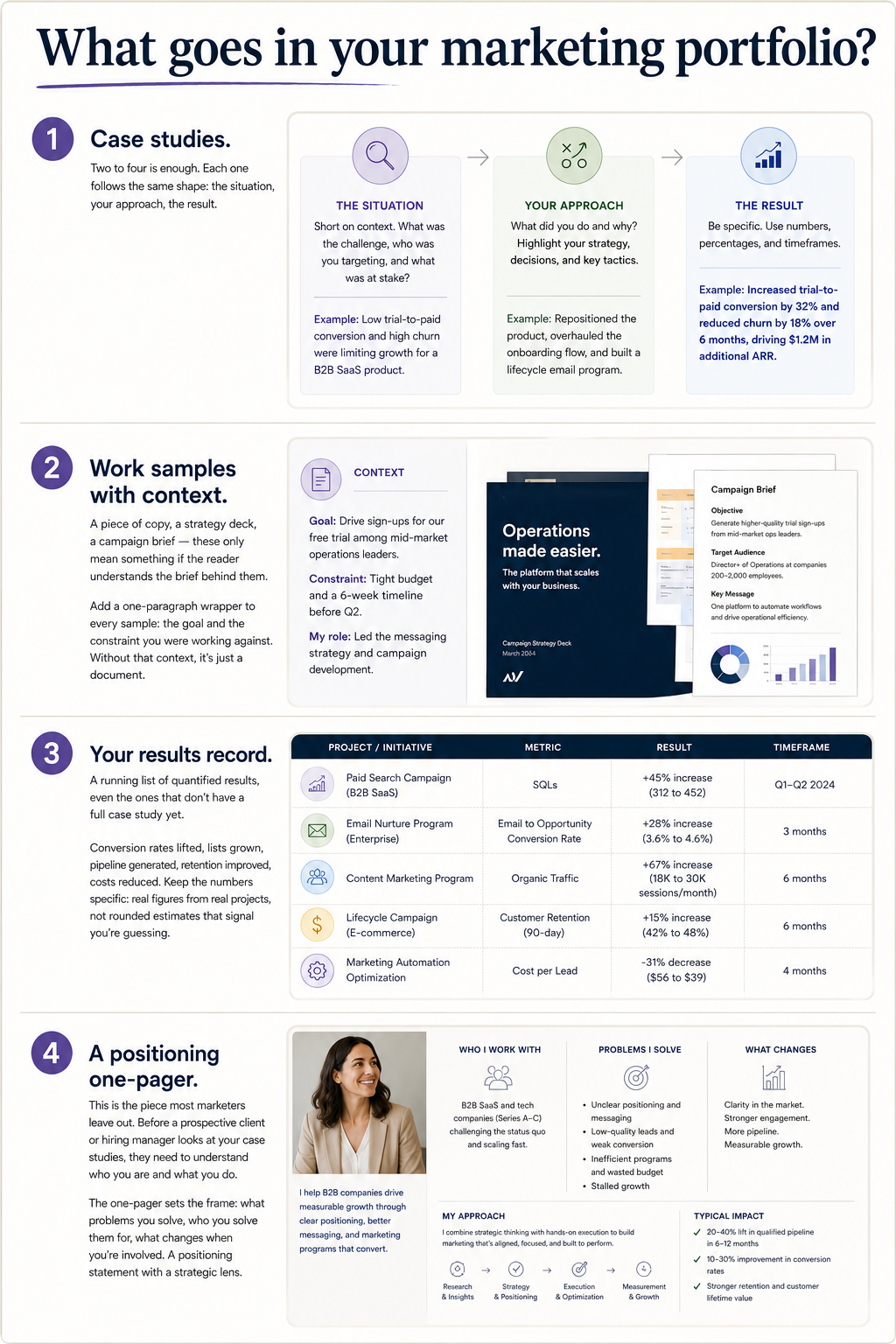
Case studies.
Two to four is enough. Each one follows the same shape: the situation, your approach, the result. Keep the situation section short (one paragraph) and make the result specific. "Grew revenue significantly" does nothing. Grew revenue by how much, over what period, from what baseline?
If you've worked on campaigns with strong results you can't disclose publicly, build a redacted version. "[Client name redacted: B2B SaaS, Series B]" is a legitimate entry. You can share results without naming the client if your NDA allows it. Most do.
Work samples with context.
A piece of copy, a strategy deck, a campaign brief — these only mean something if the reader understands the brief behind them. Add a one-paragraph wrapper to every sample: the goal and the constraint you were working against. Without that context, it's just a document.
Your results record.
A running list of quantified results, even the ones that don't have a full case study yet. Conversion rates lifted, lists grown, pipeline generated, retention improved, costs reduced. Keep the numbers specific: real figures from real projects, not rounded estimates that signal you're guessing.
A positioning one-pager.
This is the piece most marketers leave out. Before a prospective client or hiring manager looks at your case studies, they need to understand who you are and what you do. The one-pager sets the frame: what problems you solve, who you solve them for, what changes when you're involved. A positioning statement with a strategic lens.
How to format it
You don't need one format. You need the right format for the right context.
A PDF deck works for pitches and job applications. Self-contained, forwardable, and it gives you control over how it reads. Keep it under 12 slides. If you can't make your case in 12, you're including the wrong things.
A private link (Notion, Google Drive, a simple page) works for sharing specific sections mid-conversation. Someone asks about your email marketing results; you send them that section. More useful for consulting contexts where a conversation is already underway.
LinkedIn's featured section is passive and worth maintaining. A case study, a results post: these show up when people check your profile before deciding whether to reach out. Free real estate most senior marketers leave blank.
How to build it without treating it as a project
The mistake is treating the portfolio as a project. It's a habit.
After every significant project, spend 20 minutes on a case study stub. You don't have to write the full thing while you're still in it. Open a document, write three lines: the situation, your approach, the result so far. That's enough to capture the context while it's fresh. Fill it in properly later.
Set a quarterly portfolio review. 30 minutes, calendar blocked. Update your results record. Check whether any stubs have enough data to become full case studies. Refresh the positioning one-pager if your focus has shifted.
Don't wait for the perfect result. A campaign that hit 80% of its target with a clear explanation of why is a better portfolio entry than a campaign that crushed it but that you can't coherently explain. Judgment and self-awareness are part of what you're demonstrating.
Where to use it beyond the job interview
Most marketers think of the portfolio as interview collateral. That leaves most of its value sitting unused.
Client pitches. Share your positioning one-pager and a relevant case study before you write a proposal. It sets the frame for who you are before price comes up.
Rate increase conversations. Showing results from the last 12 months is a different conversation from simply announcing a new number. The portfolio is your evidence base.
Speaking and podcast pitches. Event organisers and podcast hosts want to know you've done the thing you're proposing to talk about. A case study is stronger than a bio.
LinkedIn content. Every case study in your portfolio is a LinkedIn post. Every result in your results record is a post. The portfolio feeds the content machine.
Start with what you have
Go back 12 months. Find the project you're most proud of. Write the stub: situation, approach, result. That's your first entry.
Then do it for the second one. Then set the quarterly review in your calendar.
The portfolio you build over 12 months of consistent 20-minute entries will do more for your career than the one you spend a frantic weekend producing before the pitch you care about.