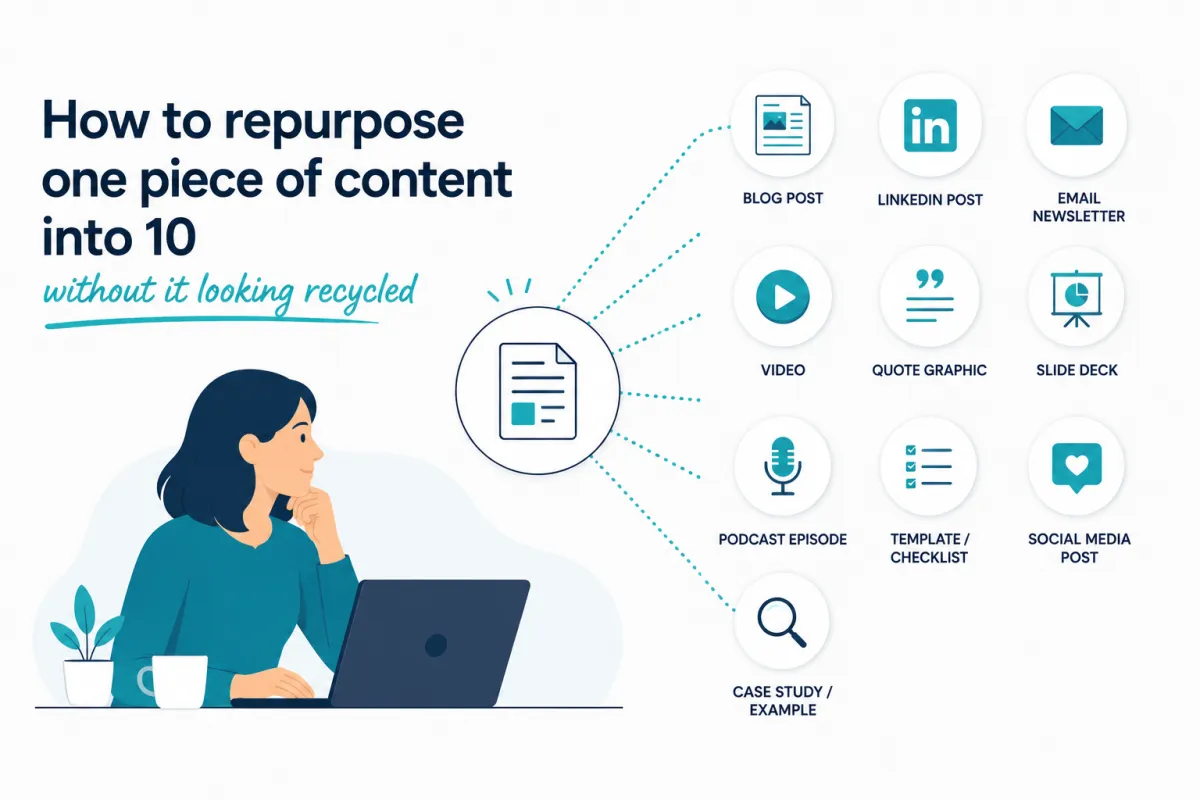
How to repurpose one piece of content into 10 without it looking recycled
How to repurpose one piece of content into 10 without it looking recycled
Most content repurposing advice is basically: write a blog post, then tweet it, then put it on LinkedIn, then make a Reel. You'll get 10 pieces of content from one!
And technically, yes. But if you've tried this, you know what the output looks like. It looks like a blog post that was cut into smaller pieces and distributed to the wrong platforms in the wrong format. It performs accordingly.
The system that actually works is built on a different premise: repurposing isn't distributing the same thing. It's extracting something from the original and rebuilding it for a different context, a different reader state, and a different platform native behaviour.
The core piece doesn't become 10 pieces of content. It becomes the source material for 10 separate content decisions. That's a meaningful distinction.
Start with a core piece worth extracting from
Not every piece of content is worth repurposing. The ones that are have at least one of the following: a framework you can apply, a counter-intuitive claim you can defend, a specific result you can reference, or a process someone can follow.
A blog post that's essentially a listicle of generic tips has nothing to extract. A blog post that lays out a 4-step decision framework, explains why the conventional approach fails, and backs the claim with a real example — that's source material.
Before building a repurposing system, build a better original. The quality of the distribution depends on the quality of what you start with.
The best source pieces for repurposing tend to be:
Long-form blog posts with a named framework
Webinar or podcast recordings where you said something specific and useful
Case studies with a concrete before/after result
Research reports or original data
If your content library has these, you're sitting on months of distribution material. If it doesn't, that's the first problem to solve.
The extraction step (what most people skip)
Before touching any platform, pull the extractable elements out of the core piece and list them separately.
From a single blog post, you might extract:
The central claim (1 sentence, defensible, specific)
The named framework (if there is one)
The 3-5 key insights (each could stand alone)
1-2 specific statistics or data points cited
The "what most people get wrong" angle
The actionable takeaway at the end
Any before/after example or case reference
Each of these is a separate content unit. Not a fragment of the original post — a discrete idea that can be built into something platform-native.
This extraction step is what separates repurposing from copy-paste distribution. You're not chopping up the post. You're inventorying the raw material it contains, then deciding which platform is the right home for each element.
Platform-native rebuilding, not reformatting
Each platform has a native content behaviour. Content that performs well there is built for that behaviour, not imported from somewhere else.
LinkedIn — the perspective post
LinkedIn's native behaviour is opinions. People open it to read takes on professional topics. The content that performs is someone's point of view, stated plainly, with enough specificity to be interesting and enough openness to prompt a response.
From your core piece, take the central claim or the "what most people get wrong" angle. Write it as a LinkedIn post from the first-person perspective. State the claim in the first line. Explain the thinking in 3-5 short paragraphs. End with a question or a direct invitation to respond.
Don't link to the blog post in the body of the post — LinkedIn suppresses reach for posts with outbound links. Put it in the first comment if you want to include it.
A 1,500-word blog post should produce 2-3 distinct LinkedIn posts from the extraction list above. Each one is a different angle on the same source material — not the same post three times.
Newsletter — the practical translation
Email newsletters work best when they're actionable and feel personal. The reader is in a different headspace than someone scrolling LinkedIn — they chose to read this, they're in their inbox, they have a few minutes.
Take one of the key insights from your core piece and rebuild it as a "here's what I'd actually do with this" email. The blog post might cover the framework at an overview level; the newsletter version gets specific about one use case, one scenario, one decision. It reads like advice from a peer who's done the thing, not a summary of an article.
Include one CTA: read the full post, download something, or reply to the email. One.
Short video script — the hook and the argument
For short video (LinkedIn native video, Reels used for reach), the structure is: hook in the first 3 seconds, one idea in 30-60 seconds, a specific takeaway at the end.
Take the "what most people get wrong" element from your extraction list. Write the script as: "Most [audience] [do the wrong thing]. Here's what's actually happening: [the real dynamic, explained simply]. What to do instead: [one concrete action]."
This isn't the blog post summarised. It's one argument from the post, stripped down to the bare version that works when someone's watching with the sound off and their attention split.
Carousel — the framework visualised
If your core piece has a named framework or a step sequence, it belongs in a carousel (LinkedIn or Instagram). The structure is: one slide per step, one key point per slide, opening slide that states the framework name and why it matters.
The visual format forces compression. If you can't put the key point for step 3 in 10 words, the framework probably isn't tight enough. The compression process often produces a sharper version of the idea than the original long-form.
A second blog post — the deep dive on one element
Most long-form posts cover ground at a certain altitude. There's almost always one section that deserves its own post.
The extraction list will tell you which element got the most out of its section word count. That's the candidate for a follow-up post. The repurposed version isn't a repost — it's a genuine extension of the original, going deeper on one dimension.
This approach also builds internal linking opportunities and topical authority. A cluster of posts on related angles of the same topic is more durable than isolated one-off articles.
The production system
The system only works if you can run it without it taking 5x the effort of writing the original. A few production rules that keep it manageable:
Batch the extraction, not the creation. After publishing a core piece, spend 30 minutes on the extraction list. Then calendar the platform-native pieces across the next 2-3 weeks. You're not making 10 pieces of content in one sitting. You're making one decision and scheduling 10 subsequent ones.
One platform-native piece per business day. If you have a 1,500-word core piece with 6 extractable elements and you're active on LinkedIn plus a newsletter, you have 2 weeks of content. The original post plus the repurposed pieces create a content cluster around a topic rather than a burst of activity followed by silence.
The original goes out first, everything else follows. The core piece is the authoritative version. Everything else points back to it, references it, or extends it. This matters for internal linking and for establishing you as the source of the idea.
What this looks like in practice
This post you're reading right now is a core piece. The extraction list from it includes: the central claim about the difference between repurposing and reformatting, the extraction step as a standalone framework, the platform-native breakdown for each channel, and the production system at the end.
That's 4 LinkedIn posts (one per section angle), a newsletter issue on the extraction process specifically, a short video script on "repurposing vs. reformatting," and a follow-up blog post that could go deeper on building a content extraction library.
So: one post, 7 additional pieces, none of them copy-paste.
The HEM content is built this way. Subscribe and you'll see the system running in real time.
Subscribe to the HEM list — the newsletter, social, and video content is all built from the same source material using this system. You'll see it from the inside.
[SUBSCRIBE TO THE HEM LIST]