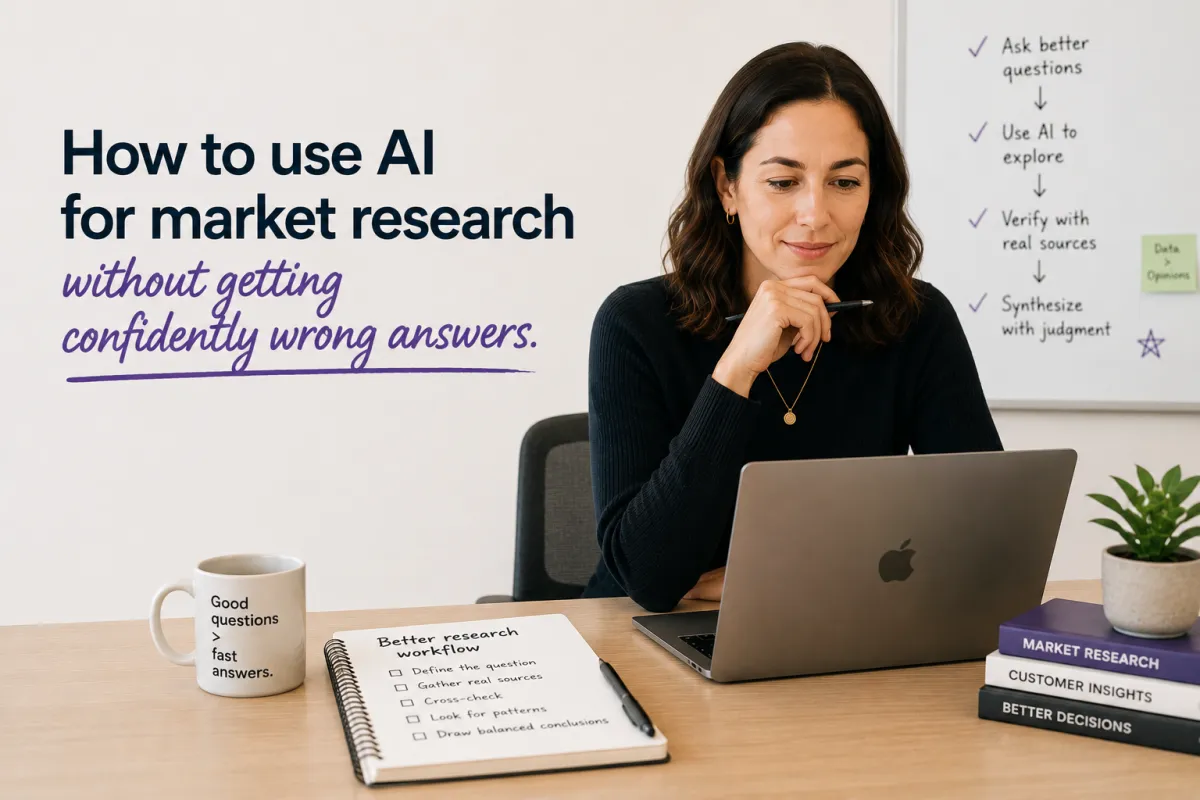
How to use AI for market research without getting confidently wrong answers
How to use AI for market research without getting confidently wrong answers
The specific danger of using AI for research isn't that it gives you wrong answers.
It's that it gives you wrong answers in the same tone, with the same confidence, and in the same format as correct ones.
When a human researcher is uncertain, it usually shows. Hedges appear. Caveats surface. The language gets a little less firm. When an AI is uncertain, it often gets more assertive — filling the gap with the most statistically plausible-sounding answer it can generate from patterns in its training data. The result is a market size figure that came from nowhere, a citation that doesn't exist, a competitor claim that's three years out of date — all delivered as though they're established facts.
68% of marketing professionals using generative AI have encountered hallucinated content in their workflows. Only 41% have formal verification processes in place to catch it. And 43% — nearly half — have had AI-generated false information get past review and go public. When researchers tested 178 citations generated by GPT-3, 69 had fake identifiers and another 28 couldn't be found anywhere online. A UC San Diego study found AI-generated product summaries hallucinated details that influenced purchase decisions 60% of the time.
AI hallucinations cost businesses an estimated $67.4 billion in 2024. For a senior marketer using AI-assisted research to brief campaigns, advise clients, or build strategy decks, the failure mode isn't a dramatic error you'd catch on review. It's the plausible-sounding figure that slips through because it looks right, lands in a client presentation, and gets pushed back on three weeks later.
The fix isn't to stop using AI for research. It's to use it the way it's actually good — and to verify the parts where it isn't.
What AI is and isn't doing when it researches
Understanding the failure mode means understanding what's happening under the hood.
An AI model doesn't retrieve facts from a database. It predicts likely outputs based on patterns in training data. When you ask it to research a market, it's generating text that resembles the kind of answer it's seen associated with that question — not consulting a live source or checking whether the number it's producing is real.
This means two categories of claim are particularly unreliable: specific statistics and citations.
Specific statistics are the main trap. Numbers that "feel right" — usually round, usually with a percentage in the 20-80% range, usually presented with a named source — are generated the same way all other text is generated. The AI isn't looking up the Gartner report. It's predicting what a statistic-with-source-citation looks like in this context, and producing one. Sometimes it happens to be accurate. Often it's a composite hallucination — real elements (a real company name, a real research area) assembled around a fabricated number.
Citations have the same problem. The author name might be real. The journal might be real. The paper doesn't exist.
The other category: anything time-sensitive. Training data has a cutoff. An AI telling you what consumers prioritise in a purchase decision, what competitors are charging, or what platform algorithms currently favour is drawing on data that may be 18 months to 2 years old. In fast-moving categories — AI itself, social platforms, anything affected by recent regulation — that's a long time.
The two-mode framework: generation vs. retrieval
The most useful reframe for AI-assisted research is to separate two distinct jobs: generation and retrieval.
Retrieval — finding facts, statistics, and source material — is where AI is unreliable without citations. Use Perplexity for this. Its design forces it to surface sources alongside answers, and those sources are clickable. The discipline of clicking through and checking that the original source actually says what the summary claims is non-negotiable. Perplexity can still be wrong, but it gives you the raw material to verify.
For financial data, market sizing, or business intelligence, go primary where possible: Statista, IBISWorld, Crunchbase, company investor relations pages, government data portals. These are slower to use but the figures they produce are attributable and defensible. An AI-generated market size figure you can't trace back to a named source is not a figure you can put in a client strategy.
Generation — synthesis, analysis, pattern recognition across material you've already gathered — is where AI is genuinely useful for research. Feed it a set of verified sources and ask it to identify themes, surface tensions, and draw out implications. Feed it customer reviews from a named platform and ask for a sentiment summary. Feed it a competitor's website, pricing page, and LinkedIn and ask it to characterise their positioning. The AI isn't retrieving here — it's processing material you've provided, which means the quality of its output is bounded by the quality of what you put in.
The workflow that holds up: gather your source material via primary sources and Perplexity, verify what matters, then use Claude or ChatGPT to synthesise. You're using generation on top of retrieval, not instead of it.
What to verify before anything leaves your desk
Four categories of claim need a verification step before they go into a brief, a deck, a client email, or any published content.
Statistics with sources. Every percentage, market size figure, growth rate, or benchmark that came from AI needs a source you can name and link to. If you can't find it, the figure doesn't get used. Rewrite the claim without the statistic, or find a verifiable figure that makes the same point.
Competitor claims. Pricing, product features, recent launches, headcount, funding status — all of this changes. An AI briefed on a competitor's position is drawing on training data, not live intelligence. Cross-check against the competitor's current website, recent press releases, LinkedIn, and job postings. Job postings in particular are a reliable real-time signal of where a competitor is investing.
Citations and academic references. If an AI produces a cited study, look it up. Not the title — find the actual paper. Google Scholar, the journal's website, the author's institutional page. If it doesn't exist, remove it.
Anything from a fast-moving category. AI search behaviour, platform algorithm changes, regulatory updates, economic conditions — ask explicitly for a time-bound scope in your prompt ("findings from 2024-2026 only") and then verify currency manually. If the AI can't confirm when the underlying data is from, treat it as suspect.
Prompting for research vs. prompting for synthesis
The way you prompt AI for research tasks should be different from the way you prompt it for writing tasks.
For research, the prompt structure that reduces hallucination is: explicit scope, explicit date range, explicit instruction to flag uncertainty. "Based only on what you know with high confidence, summarise the key buying criteria for mid-market HR software buyers. Flag anything you're uncertain about." The instruction to flag uncertainty doesn't guarantee the AI complies, but it shifts the output toward more hedged language on less certain ground — which at least signals what to verify.
For synthesis from your own provided material, the prompt structure is: paste the sources, state what you want extracted. "Here are five competitor pricing pages. Identify the pricing model each one uses, any anchoring strategies, and where the gaps are." The AI is working with your material, not its training data. The output is more reliable because the facts are coming from you.
One constraint worth applying consistently: tell the AI not to invent citations. "If you want to support a claim with a source, use [source X] that I've provided. Do not generate citations I haven't given you." This doesn't prevent all hallucination but it reduces the specific failure mode of fabricated references.
The researcher's mindset with AI tools
The marketers using AI for research well have essentially adopted a verify-first posture: they treat AI output as a hypothesis to be checked rather than a finding to be used. The tools are valuable for the pace they enable — getting to a first-cut picture of a market, a competitor landscape, or an audience segment in 20 minutes instead of 3 hours. The value holds as long as the verification step follows.
The ones who get burned skip the verification because the output looks good and the deadline is close. The stat that came from nowhere ends up on a client slide. The citation that doesn't exist ends up in a published piece. The competitive analysis that was accurate in 2023 ends up shaping a 2026 strategy.
AI makes research faster. Faster research done sloppily still produces bad strategy.
The HEM free toolkit includes a strategy one-pager template — a clean format for capturing research findings and presenting strategic recommendations without a 40-page deck.
[DOWNLOAD THE FREE TOOLKIT]