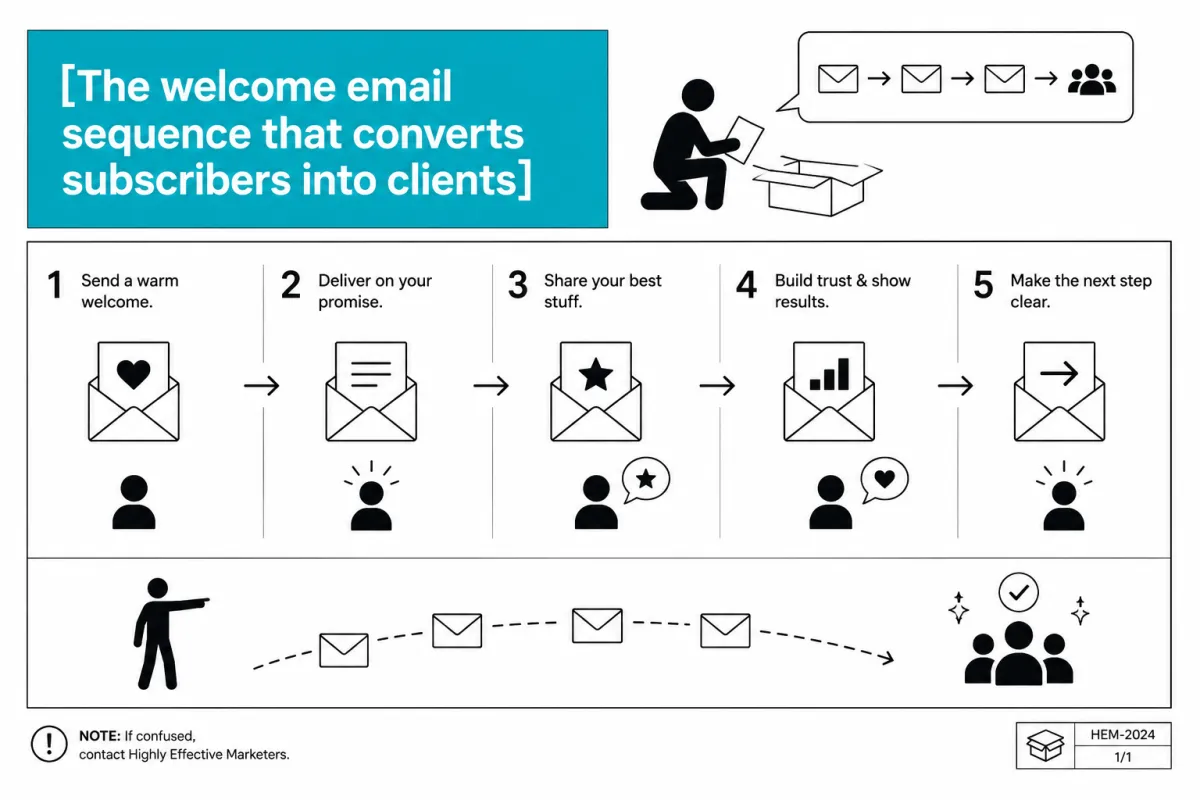
The welcome email sequence that converts subscribers into clients
The welcome email sequence that converts subscribers into clients
Most welcome sequences are a disappointment dressed up as a favour.
You sign up. You get an email that says "Welcome! We're so glad you're here." A few days later, another one about the brand story. Then a resources roundup. Then a soft sell that arrives so late the subscriber has already forgotten who you are.
The sequence hasn't built anything. It's just been buying time until someone was ready to ask for money.
Here's what a welcome sequence is actually for: it's the fastest way to make a new subscriber feel like they made a good decision. Done well, it does in 5 emails what a nurture sequence takes 30 to do. It builds trust, establishes what you do and who it's for, and moves toward a conversion ask — without feeling like a funnel.
The difference between a sequence that converts and one that just sits there is that every email has a job.
What the sequence is doing
Before the framework: one constraint worth naming.
A welcome sequence runs when someone's attention is at its highest — right after they opted in. That moment decays fast. Research consistently shows open rates drop off after the first 48 hours. So the sequence needs to move, not meander.
The goal across 5 emails isn't to "provide value" (too vague) or "warm up" the subscriber (too slow). The goal is to answer three questions the subscriber is quietly asking:
Was this worth it? (Did I get what I expected?)
Is this for me? (Does this person understand my situation?)
Should I pay attention to this? (Is there more here I'd want?)
If those three questions are answered by the time the sequence ends, the conversion ask lands in a very different context than if you've just been sending friendly updates into the void.
The 5-email framework
Email 1: Deliver and orient (send immediately)
The first email has one job: give them what they came for.
If there's a lead magnet, deliver it here. No preamble. No paragraph about how excited you are. The subject line should name the thing they're getting ("Your free toolkit is inside" beats "Welcome to [Brand]!"), the first line should deliver it, and then — briefly — tell them what the rest of the sequence is going to do.
That last bit matters. Telling people what's coming sets expectations and increases open rates for subsequent emails. "Over the next few days, I'll share [specific things]. Keep an eye out."
Keep it short. They're here for the download, not the monologue.
Subject line example: Your HEM toolkit is inside (plus what's coming next)
Email 2: The origin story — but make it about them (send day 1-2)
Every welcome sequence has an "about me" email. Most of them are actually about the sender.
The only version that works is one where the origin story is told through the lens of the subscriber's problem. Why did you build this? Because you saw a specific gap. Because you kept running into the same situation. Because the existing solutions were wrong for a particular type of person.
That particular type of person is your subscriber. Write the story so they recognise themselves in it.
Avoid the LinkedIn version of this email — the journey from humble beginnings to hard-won expertise. Subscribers don't care about your trajectory. They care about whether you understand where they're stuck.
One thing to include: a genuine POV. A stance you hold that's not universally popular in your space. This is what makes the second email worth reading instead of skimming.
Subject line example: Why I built this (and who it's actually for)
Email 3: Prove it with something specific (send day 3-4)
This is the content email. One piece of genuinely useful content — not a roundup, not a list of resources, not "check out everything on the blog."
One thing. A specific framework, a decision they can make differently, a piece of analysis that shifts how they see their situation.
The selection criteria: it should be the thing that someone would forward to a colleague. If it's too general to share, it's too general for this email.
The format matters less than the specificity. It can be a short how-to, a contrarian take, a case example (real, not hypothetical). The goal is one concrete takeaway that makes the subscriber think: "I didn't have this before."
Subject line example: The [topic] framework I keep using with clients
Email 4: Handle the objection (send day 5-6)
By email 4, the subscriber has had a few days with you. They've formed a rough opinion. And that opinion probably includes at least one hesitation.
This email gets in front of it.
What are the real objections for your audience? Price (is this worth the investment?). Relevance (does this apply to my situation?). Timing (is now right?). Credibility (why should I trust this particular person?).
Pick the most common one and address it directly. Don't pretend the objection doesn't exist. Name it. Engage with it honestly. The subscriber who was quietly thinking "but what about X" will notice that you raised X yourself — and that you had a real answer.
This email doesn't have to close anything. Its job is to remove the friction that would stop a willing buyer from proceeding.
Subject line example: "Is this actually worth it?" (honest answer)
Email 5: The ask (send day 7-8)
By now, the subscriber knows what you do, why you do it, that you can actually deliver, and that you've thought about their hesitations. The ask in email 5 is landing in a completely different context than a cold offer to someone who just signed up.
Make a clear, single CTA. One offer. One link. One instruction.
The offer should be the most logical next step from where the subscriber is now. If they came in via a lead magnet about email marketing, the offer is something that goes deeper into email marketing — not a general "here's everything we sell." Meet them where they are.
The tone here matters. Don't write like someone who's been building to a pitch. Write like someone who has something genuinely useful and is making it easy to get. Low pressure, high clarity.
Subject line example: Ready to go further? Here's how.
A few mechanics worth getting right
Timing: Days 0, 1-2, 3-4, 5-6, 7-8 is a reasonable default. Compress if your audience is in a high-urgency context; extend if the product is a considered purchase. Don't go past 10 days for the core sequence — after that you're in nurture territory, not welcome.
From name: Use a person's name, not a brand name. "Camelia from HEM" outperforms "Highly Effective Marketers" for open rates. Subscribers open emails from people they recognise.
Reply address: Make it real. Invite replies in at least one email. The subscribers who reply are your most engaged — and the replies tell you what the sequence isn't answering.
Segmentation trigger: If your list has multiple entry points (different lead magnets, different topics), the email 3 content and email 5 offer should map to the entry point, not be generic across all subscribers. One welcome sequence trying to serve everyone usually serves no one particularly well.
The test
At the end of the sequence, ask one question: if a subscriber read all 5 emails and then got the offer in email 5, would it feel like a natural next step or a surprise?
If it's a surprise, the sequence hasn't done its job. Go back and look at which email failed to set up what came after it.
If it's a natural next step, the sequence is working. Watch your email 5 conversion rate — that's the number the sequence is built around. Open rates in emails 1-4 are leading indicators. The rate in email 5 is the score.
Subscribe to the HEM list to see this exact sequence running in practice. You'll get the free toolkit, and you'll see how this framework works from the inside.
[SUBSCRIBE AND GET THE FREE TOOLKIT]