
For marketers who already know the basics
WHERE SMART MARKETERS COME TO GET SHARPER
Templates and frameworks for senior marketers who want their careers to compound. Built by someone who still runs campaigns.
Free. Five templates, plus a walkthrough for each.
For marketers who already know the basics
WHERE SMART MARKETERS COME TO GET SHARPER
Templates and frameworks for senior marketers who want their careers to compound. Built by someone who still runs campaigns.
Free. Five templates, plus a walkthrough for each.
WE'RE NOT FOR EVERYONE
But if any of this sounds like you, you're home:

You're the one your team comes to for answers, and quietly bored of your own playbook.
You're sick of advice from people who've never actually run a campaign.
You want real marketing intelligence, not LinkedIn broetry.
WE'RE NOT FOR EVERYONE
But if any of this sounds like you, you're home:
You're the one your team comes to for answers, and quietly bored of your own playbook.
You're sick of advice from people who've never actually run a campaign.
You want real marketing intelligence, not LinkedIn broetry.
WE GIVE GOOD MARKETERS
GREAT TOOLS

STRATEGIC INSIGHT
Frameworks that compound, so this year's work makes next year easier.

TEMPLATES & CHECKLISTS
The proposals, audits, onboarding kits and pricing frameworks you'd have built yourself, if you ever got a spare weekend.

COURSES & WORKSHOPS
Tactical training for busy marketers. Learn it Tuesday, use it Wednesday.

COMMUNITY & MENTORSHIP
A room of marketers who actually get it. Ask the awkward questions here, not on your boss's time.
WE GIVE GOOD MARKETERS
GREAT TOOLS
STRATEGIC INSIGHT
Frameworks that compound, so this year's work makes next year easier.
TEMPLATES & CHECKLISTS
The proposals, audits, onboarding kits and pricing frameworks you'd have built yourself, if you ever got a spare weekend.
COURSES & WORKSHOPS
Tactical training for busy marketers. Learn it Tuesday, use it Wednesday.
COMMUNITY & MENTORSHIP
A room of marketers who actually get it. Ask the awkward questions here, not on your boss's time.
Where Are You On The Ladder?
Wherever you are, there's a template, a tool or a mentor here to help you climb.
THE DOER
You get things done, but you're stuck in execution mode.
THE STRATEGIST
You plan and deliver, and you still have to convince the room you're the expert.
THE LEADER
You've got a team and you're ready for the next leap.
THE CONSULTANT
You want better clients, stronger offers, clearer positioning.
THE RAINMAKER
You're building assets. IP, authority, the legacy stuff.
START WITH THE
FREE TOOLKIT
The Strategic Marketer's Toolkit: the proposal template, campaign plan, strategy one-pager, pricing framework and positioning map I use with clients, plus a walkthrough so you can run them like you've had them for years.
You'll also get the HEM newsletter. Short, honest, mostly weekly. Marketing systems for the people who run them.

START WITH THE
FREE TOOLKIT
The Strategic Marketer's Toolkit: the proposal template, campaign plan, strategy one-pager, pricing framework and positioning map I use with clients, plus a walkthrough so you can run them like you've had them for years.
You'll also get the HEM newsletter. Short, honest, mostly weekly. Marketing systems for the people who run them.
WANT A HAND PUTTING IT TO WORK?
DONE WITH YOU.
Audits, strategy sessions and templates that plug into how you already work. You drive, I navigate.
Not sure where the gaps are? Start with a Clarity Scan.
WANT A HAND PUTTING IT TO WORK?
DONE WITH YOU.
Audits, strategy sessions and templates that plug into how you already work. You drive, I navigate.
Not sure where the gaps are? Start with a Clarity Scan.
THE PROOF
RESULTS THAT SPEAK VOLUMES
★★★★★
“Working on a project with Camelia has been enjoyable, and her knowledge of SEO and marketing is unmatched. She contributes a special combination of strategic thought and creativity to our project. Her wealth of knowledge and commitment helped assist my businesses in expanding our revenue and brand. For anyone hoping to improve their marketing efforts and find long-term success, I highly recommend Camelia.”
Terence Kam
Stratigus, Bella Vista
★★★★★
“Camelia Vasile is a smart, brilliant, caring and strong Manager who understands process and people. She does a great job, highly recommended and I LOVE HER WORK!”
Edward Zia
Business Networking Specialist, Sydney
★★★★★
“Exceptional salesperson, and an exceptional person. Highly recommended.”
Tony Gray
Business start-up and turnaround specialist, London
Fresh From The Blog
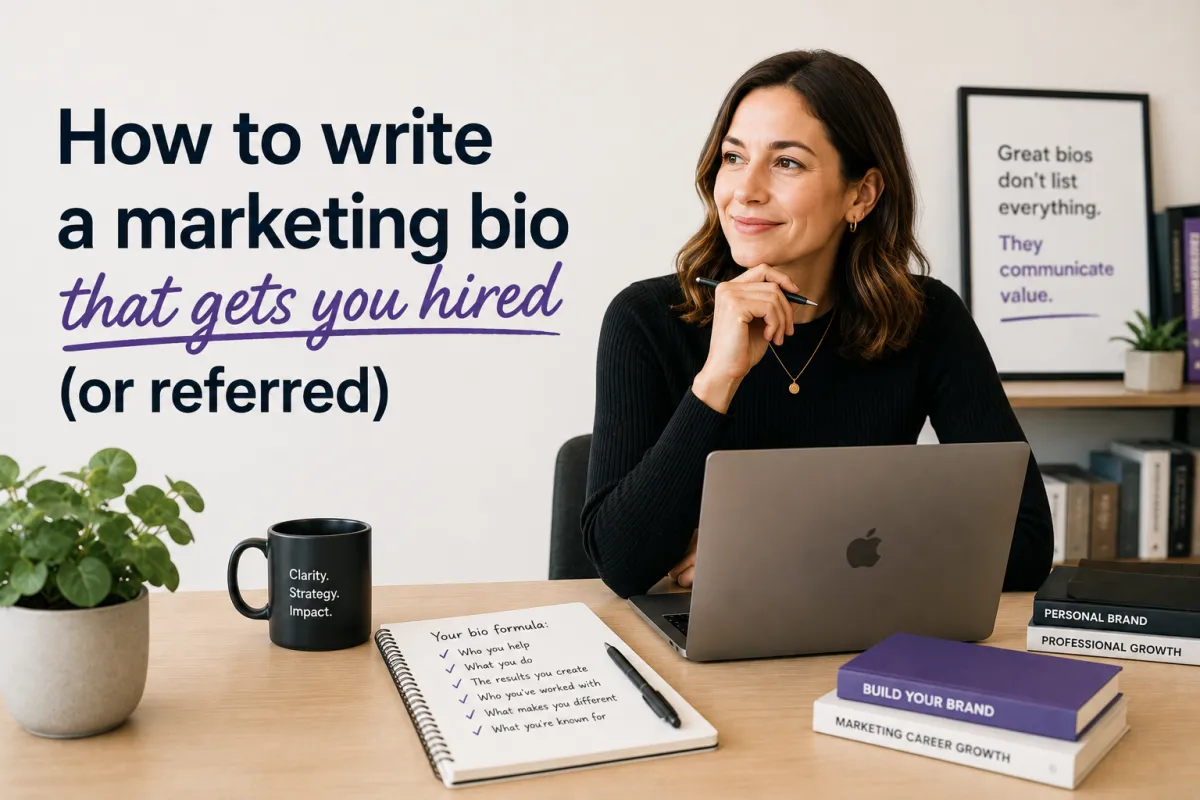
How to write a marketing bio that gets you hired (or referred)
How to write a marketing bio that gets you hired (or referred)
Pull up your LinkedIn About section or your website bio right now.
Does the first sentence describe you? Your years of experience, your title, your specialisations, your passion for something?
If yes, you've written a bio that serves you and loses the reader.
The person reading it (the prospective client, the recruiter, the referral deciding whether to pass your name along) doesn't care about your career arc in the first sentence. They care about whether you're relevant to them. Whether you understand their situation. Whether you've seen their problem before.
A bio that answers those questions generates enquiries. A bio that summarises your CV generates polite indifference.
Here's the difference between the two, and how to rewrite yours.
The inside-out problem
Most marketing professionals write their bio from the inside out. They start with themselves: who they are and what they've done. Then they list services. Then they add a line about passion or approach. Then they stop.
It reads like a resumé summary. Which is fine if you're applying for jobs. For generating inbound or building a referral network, it leaves most of the work undone.
The prospective client who lands on your profile doesn't know yet whether you're relevant to them. Your bio's first job is to answer that question: fast, specifically, from their direction.
That means starting with them.
The outside-in reframe
An outside-in bio opens with the client's situation. It names the problem they have. It explains where you come in and what changes. Credentials come last, as proof rather than pitch.
Before and after. Same person, completely different effect.
Before:
"Sarah is a senior marketing strategist with 12 years' experience across B2B and B2C brands. She specialises in brand strategy, content marketing, and digital communications. Sarah holds an MBA and has worked with clients across financial services, professional services, and technology. She is passionate about building brands that connect with their audiences."
Read this as a prospective client. What do you know? Sarah has been doing marketing for a while. She works across a wide range of things.
What you don't know: whether she's seen your specific problem, or why you should contact her rather than the ten other consultants with similar CVs.
After:
"Sarah works with professional services firms that have strong expertise but struggle to translate it into visible market presence (the firms that are genuinely good at what they do and perpetually frustrated that their pipeline doesn't reflect it). She helps them identify what makes them specifically different, then build the content and positioning infrastructure to make that difference visible. Most of her clients see inbound enquiries shift within the first six months.
15 years in B2B marketing strategy. MBA. Previously at [agency/company]."
Same person. The first version summarises a career. The second version describes someone who understands a specific situation, works with a specific type of client, and has seen specific results. The credentials are still there, doing a different job.
The rewrite framework
Line 1: Name the client.
Who specifically do you work with? The more specific you are, the more the right reader feels immediately addressed.
"I work with B2B technology companies..." is better than "I work with businesses." "I work with B2B technology companies that have built a strong sales-led motion and are trying to shift toward product-led growth" is better still.
Line 2: Name the problem.
What situation are they in? What's the thing they're trying to fix or achieve? Make it specific enough that someone who has that problem recognises themselves.
The test: can a prospective client read this line and think "that's us"?
Line 3: Describe your entry point.
What do you do, and what changes because you do it? One sentence. Outcomes matter more than methodology.
Line 4: One proof point.
A result or a specific outcome you've seen. Something concrete that makes the preceding lines credible.
Line 5 (optional): Credentials.
Brief. One sentence. Years of experience and notable employers or clients. The "why you can trust what came before" line.
Where to use it
The bio you've just rewritten belongs everywhere someone might be deciding whether to contact you.
LinkedIn About section. The first two sentences carry the most weight because that's all most people see before clicking "see more." Make those two sentences the client's situation and your entry point.
Website About page. You have more room here, so you can go deeper on proof: case study references, types of clients, specific results. The same outside-in structure still applies. Start with them, end with you.
Speaker bio (conference/podcast). Event organisers and hosts are choosing between multiple possible guests. The bio that describes who benefits from hearing you consistently beats the bio that lists your career highlights.
Email signatures and proposals. A one-line version of your positioning, the client and the problem, does more work in a proposal context than your title and company name.
The one rewrite worth doing this week
Take the first sentence of your current bio. Read it as a prospective client. Does it answer "is this person relevant to me" in their language, or does it describe you in yours?
If it's the latter, rewrite that sentence only. One sentence: who you work with and what problem you help them solve. Then update every place your bio lives.
Get the first sentence right, and the rest of the bio has something to build on.
The HEM free toolkit includes a positioning map template: the exercise that forces you to answer "who specifically" and "what problem specifically" before you write a word of your bio. The map becomes the source material for every version of your bio across every platform.

Who's this for?
Senior marketers, consultants, managers and specialists who want to get promoted without kissing up, win better clients without sounding desperate, and build authority that isn't just posts chasing likes. If you've ever been told you're 'too senior' for the junior stuff but 'not quite ready' for the corner office, this was built for you.
Is this just another marketing membership?
It's a toolkit and a newsletter, plus paid programs when you want to go deeper. Frameworks, files and training you can use the same week. Use what you need and ignore the rest.
Are the paid programs actually worth it?
If you want to stop reinventing the wheel, yes. One decent client or one good strategic move pays for them many times over. Frameworks, files and fast wins, minus the fluff.
What do I get with the free toolkit?
Instant access to five templates (proposal, campaign plan, strategy one-pager, pricing framework, positioning map), a walkthrough for each, and the quiet satisfaction when your boss or client asks where you got them.
I'm happy in my job. Why would I need this?
Good. Stay happy. HEM is about making sure your career compounds while you're there, with sharper work and the visibility to match.
Who's behind it?
Camelia Vasile, a full-stack marketer who's done the strategy, the copy, the build and the reporting, and got tired of watching good marketers held back by bad advice.
STRAIGHT ANSWERS
You've got questions.
We've got straight answers.
YOU'RE GOOD. GO AND
GET BRILLIANT
Keep doing great work that quietly plateaus, or grab the toolkit and give your career the compounding it's owed.
The toolkit's free either way.
YOU'RE GOOD. GO AND
GET BRILLIANT
Keep doing great work that quietly plateaus, or grab the toolkit and give your career the compounding it's owed.
The toolkit's free either way.
FOLLOW US

Copyright 2026. Highly Effective Marketers. All Rights Reserved. ABN 13 536 702 903. Privacy Policy | Terms